The Kaiser and his personality
Democracy vs dictatorship
The course covers how Germany went from a monarchy under Kaiser Wilhelm II, to a democracy (the Weimar Republic) after WWI, to a Nazi dictatorship under Hitler.
- Democracy - a system of government where people vote for their leaders. People typically have more rights and freedoms.
- Dictatorship - a system of government where one person or small group has absolute power and controls all aspects of society.
How Germany was created
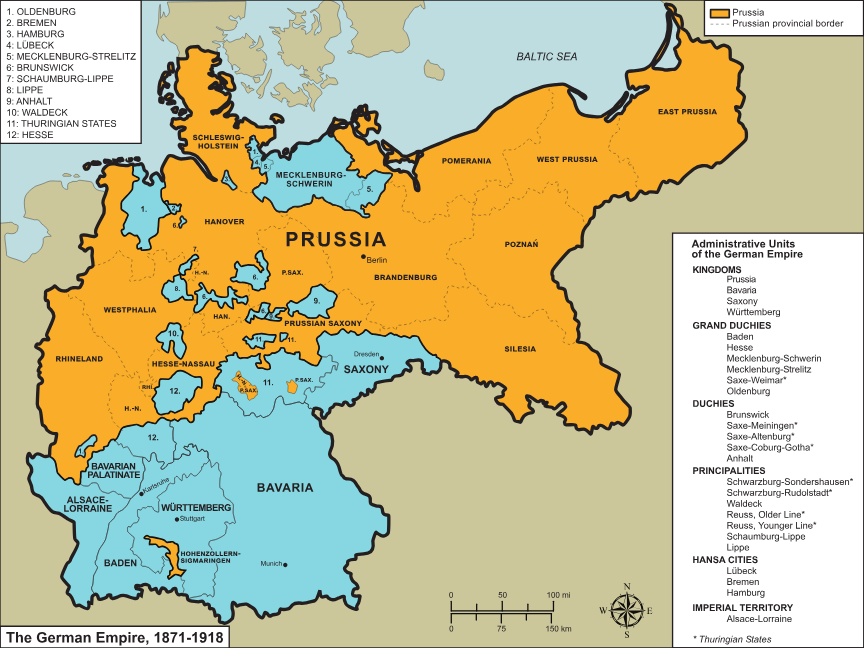
Germany used to be a collection of states, all run by different rulers. In 1871 they united. The king of the most powerful state, Prussia, became its new ruler, or Kaiser. Kaiser Wilhelm II came to the throne in 1888.
Wilhelm II was the grandson of Queen Victoria of Britain and the cousin of Tsar Nicholas II of Russia.
Parliamentary Government
| Kaiser (leader of Germany) |
Ruled over all the states of Germany. He controlled the army, appointed and could sack the Chancellor, and could veto (block) any law passed by the Reichstag. Could ignore government advice and made all military and foreign policy decisions. |
|---|---|
| Chancellor (chief minister) |
Appointed by the Kaiser. He and the ministers advised the Kaiser, and he decided which laws the Reichstag would discuss and vote on. |
| Bundesrat | Made up of representatives from each state; helped make and pass laws. |
| Reichstag (parliament) |
Elected by men over 25. Debated and voted on laws drawn up by the Kaiser and ministers, but could not create its own laws. |
| Electorate | Men aged over 25, who voted for members of the Reichstag. The people they voted for belonged to political parties. |
How Prussia boosted the Kaiser’s power
- Prussian militarism - Prussia had the strongest military of all the German states, with the largest army and up-to-date weapons. The Kaiser took personal charge of the army, and it swore an oath of loyalty to him, not to Germany.
- The Bundesrat - 14 votes were needed to block a law. Prussia had 17 members, more than enough to block any law the Kaiser disagreed with.
- The Junkers - powerful Prussian landowning nobles. They held top jobs in the civil service, diplomacy and the military, and were loyal to the Kaiser.
Kaiser Wilhelm II
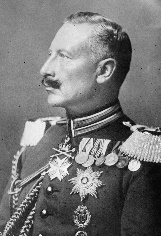
- Spent most of his youth in the army
- Keen to maintain a powerful army and build up a large navy
- Took great pride in leading the army and was very interested in military tactics
- Wanted Germany to be a global power and have an empire to rival Britain’s; this idea is Weltpolitik – world policy
- Was from Prussia; militarism – the belief that a country should have strong armed forces – was important to Prussia; Prussian generals, army officers and tactics formed the basis of the new united Germany
Exam tip: "Describe two..." [4 marks]
e.g. Describe two problems faced by Kaiser Wilhelm II’s governments in ruling Germany up to 1914. Identify two problems (e.g. the growth of trade unions, the rise of the SPD) and write 2-3 sentences on each: what the problem was, and why it was a problem.